Why Market Growth Is Not Development Uplift
Most investors confuse market appreciation with development uplift. Learn why separating market growth from value created through refurbishment, extensions, and development is critical for accurate feasibility analysis and better investment decisions.
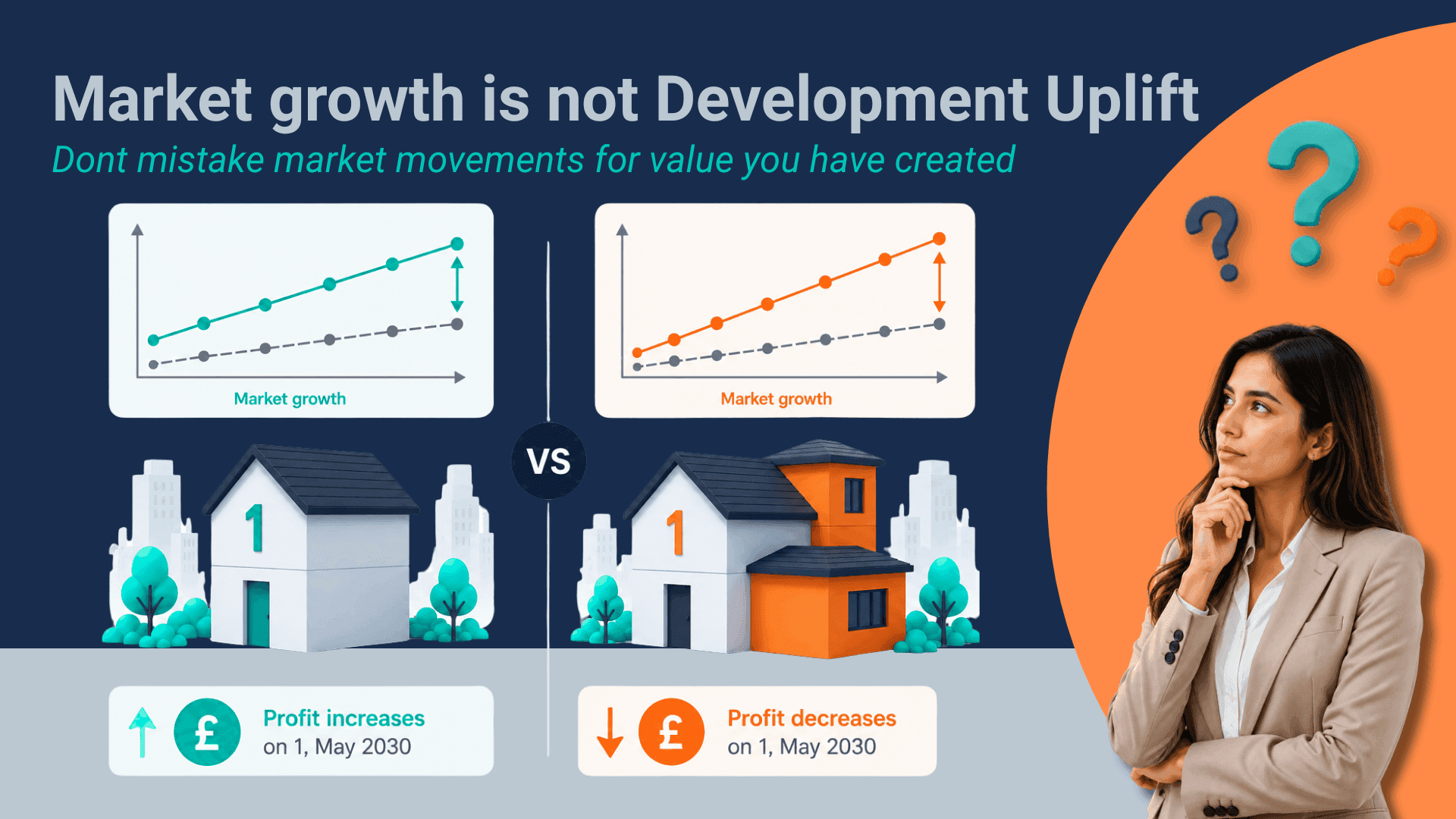
In residential property discussions, projected gains are often framed as “uplift.” Yet in practice, much of what is described as uplift is simply general market appreciation.
This distinction matters.
If a local market has grown by 6% over the past 12 months, and a property increases in value by 6% after works are completed, the investor has not created value — they have merely tracked the market.
True development-driven uplift is the value created beyond prevailing market growth.
The problem is that most valuation-stage conversations do not separate the two. Agents reference comparable sales. Developers estimate resale value post-extension. Investors apply instinct.
Very rarely is the projected gain benchmarked against local growth behaviour.
This leads to three recurring risks:
- Overestimating the impact of cosmetic refurbishment
- Confusing rising markets with a value-add strategy
- Underestimating risk when markets soften
A structured feasibility model must therefore ask a simple question:
Does the projected uplift materially exceed local growth trends?
If it does, the value is likely being driven by development works — additional floor area, improved layout, enhanced specification or increased functionality.
If it does not, the gain may be market-driven rather than strategy-driven.
This distinction is especially important in suburban markets where modest extensions are common. A rear extension that increases value by £40,000 sounds compelling — until one recognises that comparable properties in the area have appreciated by a similar amount without any works.
Separating development-driven uplift from general market appreciation introduces analytical discipline into residential acquisition decisions.
It reframes the conversation from:
“What could this be worth?”
to:
“What value are we actually creating?”
In a market increasingly shaped by tighter margins and greater scrutiny from lenders, structured uplift modelling is not a luxury. It is a risk management tool.
[001]
See it on a real property
Run a structured feasibility report in seconds.