How Planning Density Signals Latent Value in Residential Streets
Planning density reveals more than application activity. Discover how extension approvals, local precedent, and street-level planning behaviour can uncover hidden development opportunities and support more informed property decisions.
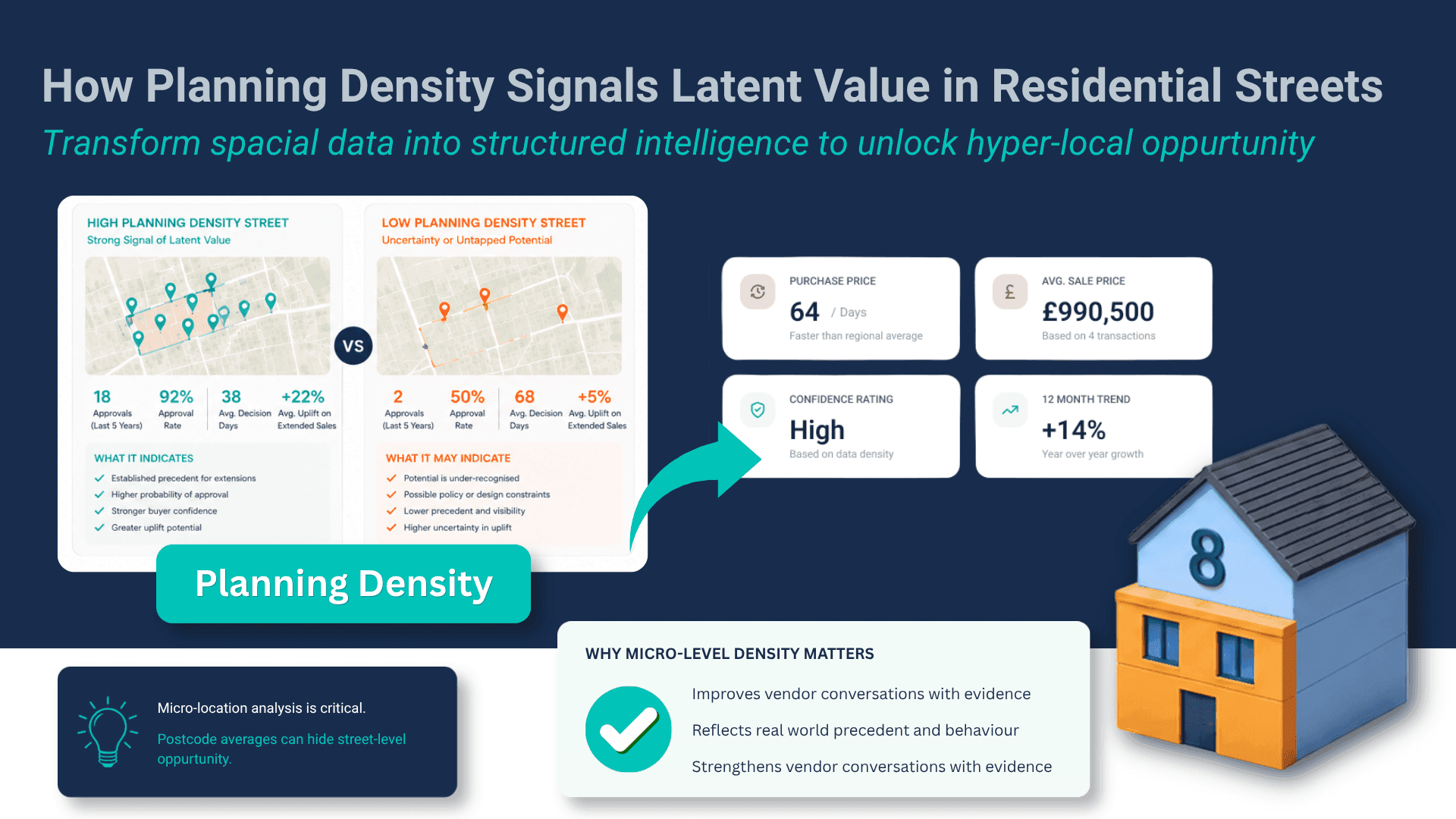
Not all streets behave equally; Some display visible signs of intensification: loft dormers, rear extensions, side returns. Others remain largely unaltered.
Planning application density provides insight into this behavioural pattern, and high concentrations of householder applications within a micro-location suggest:
• Market acceptance of extension works
• Established contractor familiarity
• Precedent-driven approvals
• Buyer appetite for larger footprint properties
This density acts as a proxy for latent value recognition; Where multiple properties in close proximity have successfully extended, the likelihood of similar works being viable increases.
In contrast, low planning density in structurally extendable areas may signal:
• Under-recognised development potential
• Policy constraints
• Demographic factors influencing housing behaviour
For estate agents and investors, micro-level planning density provides more granular intelligence than borough-wide averages. A postcode-level approval rate may mask street-level opportunity.
Integrating planning density into feasibility modelling allows uplift projections to be framed within realistic local precedent. It also supports more informed conversations with vendors:
“This street has seen 18 rear extension approvals in the past five years.”
Such statements carry evidential weight, and when planning data, when analysed spatially, transforms anecdote into structured intelligence.
[005]
See it on a real property
Run a structured feasibility report in seconds.