What Planning Approval Rates Really Tell You About Development Risk
Planning approval rates can reveal valuable insights about development probability, local authority behaviour and project risk. Learn how structured planning intelligence can improve feasibility modelling and reduce uncertainty.
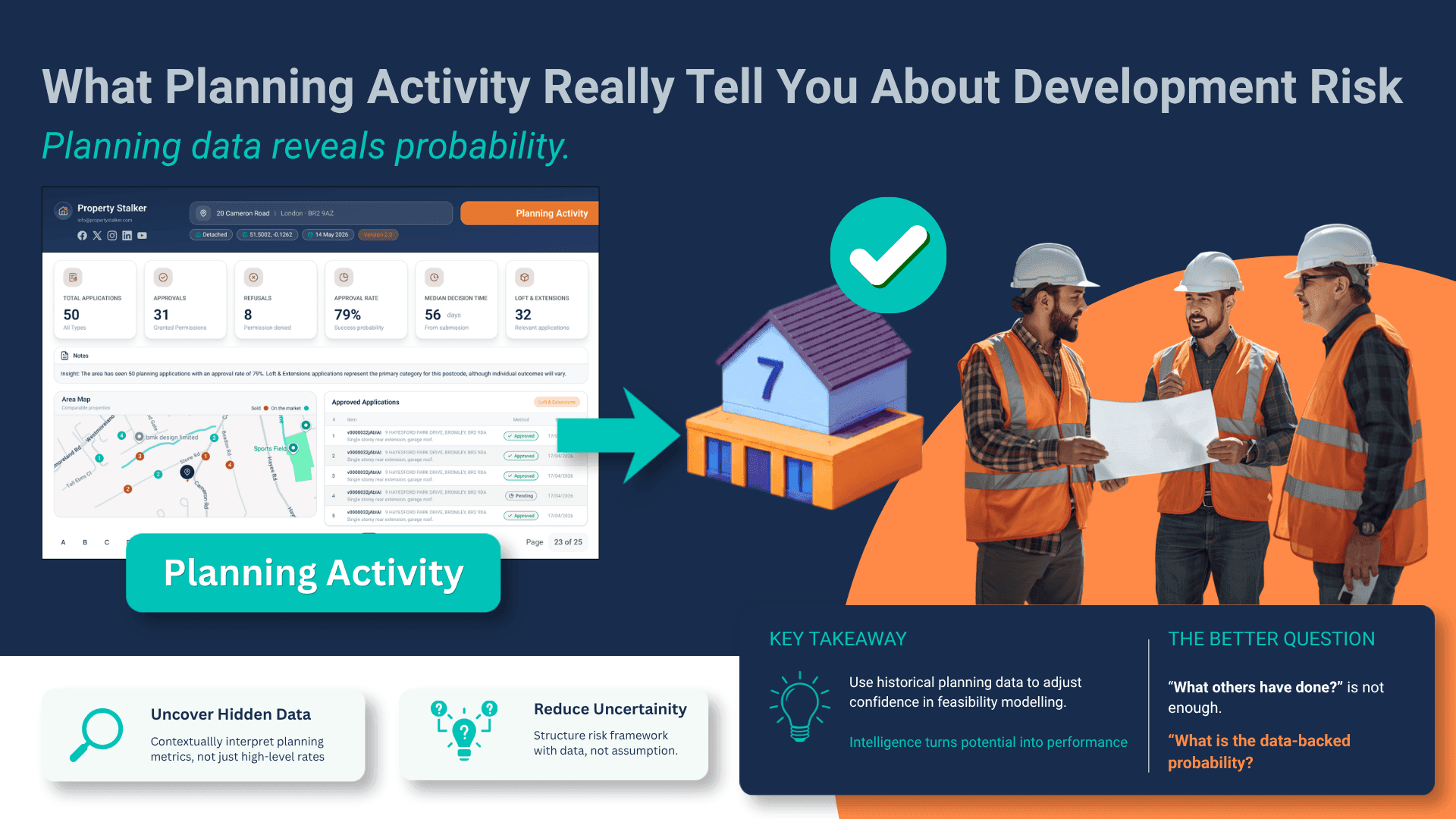
Planning data is often referenced casually in property discussions:
“Others have done extensions in the street.”...“The council usually approves lofts.”
But anecdotal evidence is not risk analysis. Planning approval rates, when examined systematically, provide measurable indicators of development probability. If a local authority demonstrates:
• A high volume of householder applications
• A strong approval ratio
• Consistent approval of loft and rear extensions
• Predictable median decision times
This suggests institutional acceptance of residential intensification in that area. Conversely, lower approval ratios, longer decision times, or high refusal rates may indicate policy constraints, conservation sensitivities or community resistance.
However, interpreting planning data requires nuance. An area with many applications but low approval rates may signal speculative submissions rather than realistic schemes. Similarly, a low number of applications does not necessarily imply resistance it may reflect limited extension capacity within the housing stock.
The key is contextual interpretation. Planning data should not be used as a binary “yes/no” signal. Instead, it should inform probability weighting within feasibility modelling.
For example:
• A strong approval history may justify higher confidence bands in GDV modelling.
• A constrained planning environment may warrant conservative projections or contingency allowances.
In structured feasibility analysis, planning data becomes part of a broader risk framework not a standalone indicator. Used correctly, it reduces uncertainty. Used superficially, it reinforces assumptions.
[004]
See it on a real property
Run a structured feasibility report in seconds.