How Estate Agents Can Increase Instruction 'Win-Rate' by Quantifying Development Potential
Estate agents can win more instructions by moving beyond opinion and showing vendors quantified development potential, including build cost, ROI, post-extension value, and local growth comparison.
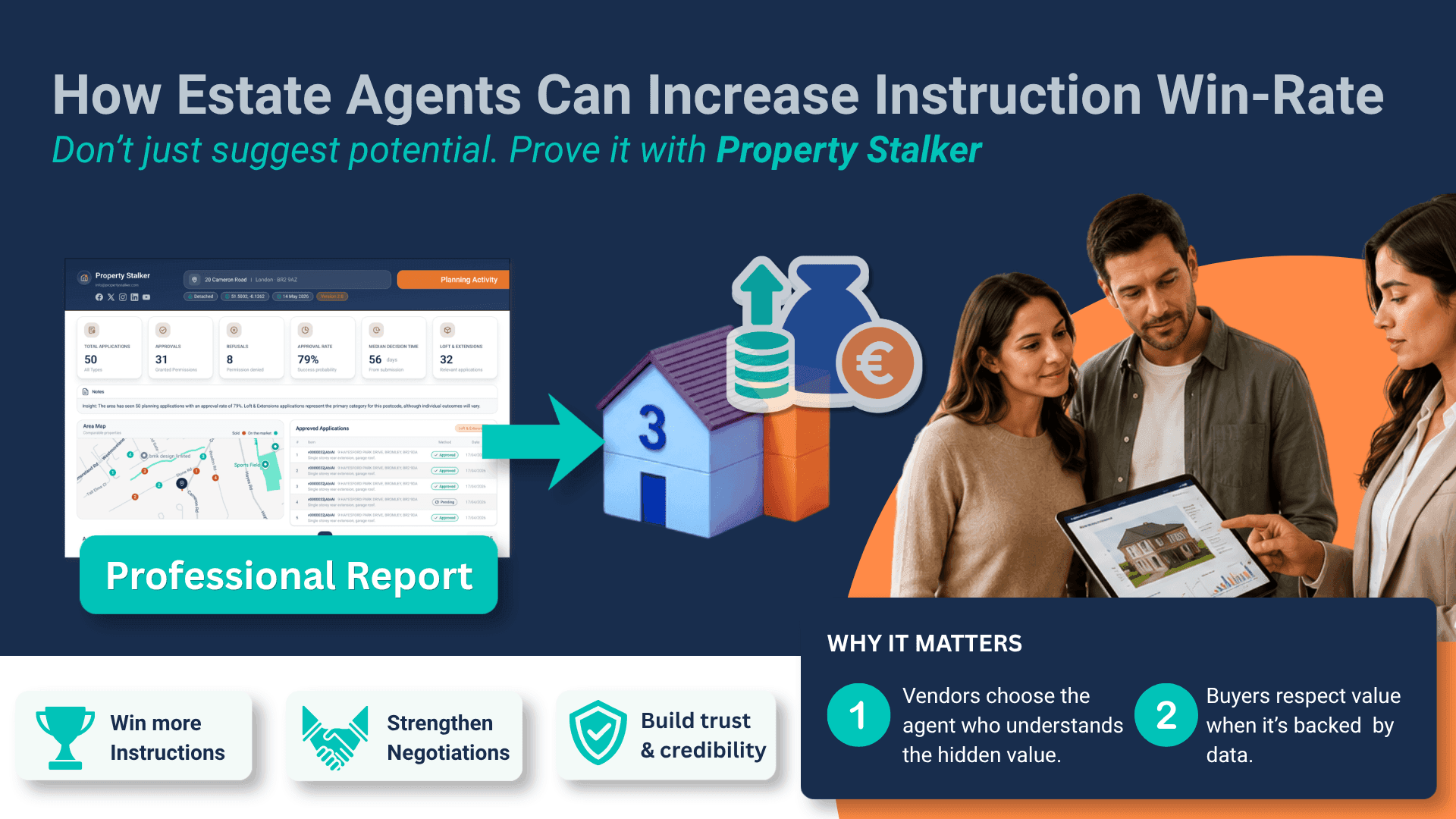
Estate agency competition is frequently centred on fee.
Yet in many valuation appointments, the most under-utilised lever is not commission, it is intelligence. When a property possesses latent development potential, the agent who can quantify that potential holds a significant advantage.
Most agents will mention:
“You could extend here.” … “There’s loft potential.” “Others in the street have done similar.”
However, these statements are qualitative. Vendors respond more strongly to structured evidence. If an agent can demonstrate:
• Estimated extension size
• Indicative build cost
• Projected post-extension value
• Return on investment
• Comparison to local growth
The conversation shifts. Instead of competing on optimism, the agent competes on insight.
This matters for two reasons.
1. vendors selecting an agent often favour the one who appears most informed about hidden value.
2. Buyers viewing a property are less inclined to negotiate aggressively if they understand the quantified upside.
In effect, structured uplift modelling serves two commercial purposes:
1. It supports instruction win-rate at valuation stage.
2. It supports price integrity during negotiation.
For branch networks, even a modest increase in instructions attributable to development intelligence can materially impact annual revenue. Apps such as Property Stalker provide the intelligence needed to instruct the vendor with this data.
The key is discipline.
Development potential must be modelled using authoritative data and realistic cost assumptions. Overstating uplift undermines credibility. Quantified feasibility — properly structured — transforms the role of the estate agent from transactional intermediary to informed advisor. In an environment where fee pressure persists, intelligence-led differentiation becomes increasingly valuable.
[002]
See it on a real property
Run a structured feasibility report in seconds.